Screenshot API Usage Logs
Usage logs surface every Screenshot API call in real time, making it easy to audit automation, troubleshoot storage integrations, or prove compliance. Because Add Screenshots never throttles requests, logs help you understand exactly how each capture was processed across three regions and destinations.
Related: website screenshot API overview, full page website screenshots, URL to image converter, PNG vs JPEG format guide, and JSON base64 responses.
Use the logs to answer questions such as: Did my webhook fire successfully? Which URLs triggered a 424 response? Which storage template handled last night's scheduled captures?
Accessing Usage Logs on Add Screenshots
You can find usage logs for your website screenshots on the Usage Logs page within the Add Screenshots portal.
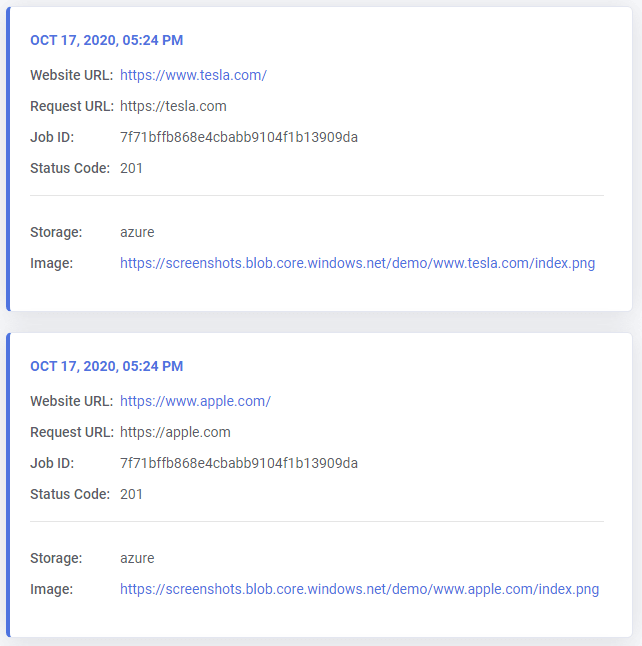
These logs typically include the following information, depending on the request type and status:
- Date - Date and time of the screenshot request
- Request URL - The requested website URL (e.g., example.com)
- Website URL - Final website URL after redirection (e.g., https://www.example.com/)
- Status Code - HTTP status code of the web response (e.g., 200 OK, 201 CREATED)
- IP Address - IP address of the requesting client
- Country Code - Country code of the requesting client
- Referrer - Referring website
- Region - Screenshot API region
- Job ID - Unique identifier for multi or bulk screenshot requests
- Error - Debug information returned by the website, if applicable
- Storage - Name of the storage provider (e.g., S3, Azure)
- Image - URL of the screenshot image
- Image Old - URL of the archived image for track changes
- Image Diff - URL of the diff image comparison for track changes
Filter, Export, and Drill Into Requests
- Filter by any column: Narrow the table by URL, region, status code, or storage provider to isolate problem calls.
- Download CSV exports: Use the Export button on the Usage Logs page to archive a day, week, or month of activity for auditing.
- Inspect job details: Click the
job_idto view the bulk job page, diff images, and any associated webhooks. - Correlate with webhooks: Match timestamps and
request_idvalues with payloads sent to your webhook endpoint for end-to-end traceability.
Best Practices
- Bookmark the Usage Logs portal for quick access during deployments or marketing campaigns.
- Use the export to feed BI dashboards or send alerts when error rates spike.
- Combine logs with storage templates to confirm every screenshot landed in the right bucket or FTP server.
Below is an example of usage log entries:
Ready to monitor your captures in real time? View plans or open the Usage Logs dashboard to explore recent activity.