Rendered DOM access
Extract content after client-side scripts, authentication, and dynamic components have loaded.
This API reference shows developers how to load a page in a real browser, run extraction JavaScript, and return clean JSON for analytics, monitoring, or downstream automation. Want to experiment first? Try the free online HTML to JSON converter tool.
<article class="product">
  <h2>iPhone 15</h2>
  <span class="price">$799</span>
</article>{
"name": "iPhone 15",
"price": 799,
"currency": "USD"
}Add Screenshots opens the target in a browser, executes your JavaScript against the live DOM, and returns the value as structured JSON.
Extract content after client-side scripts, authentication, and dynamic components have loaded.
Use familiar browser JavaScript to select, normalize, and return exactly the fields you need.
Send JSON to cloud storage, webhooks, email, or the analytics workflow you already operate.
Browser execution makes the workflow useful when source HTML alone does not contain the final data presented to visitors.
Track availability, prices, variants, and product attributes across online catalogues.
Collect comparable pricing and feature data for recurring market reviews.
Normalize reviews, promotions, listings, or other structured page content.
Extract rendered market values and indicators for downstream analysis tools.
Build and test the extraction in the browser first, then pass the script to the API for repeatable execution.
You need to know the URL of the website from which you want to extract data.
For example, to extract prices for iPhones from the Apple website, the URL would be:
https://www.apple.com/iphone/
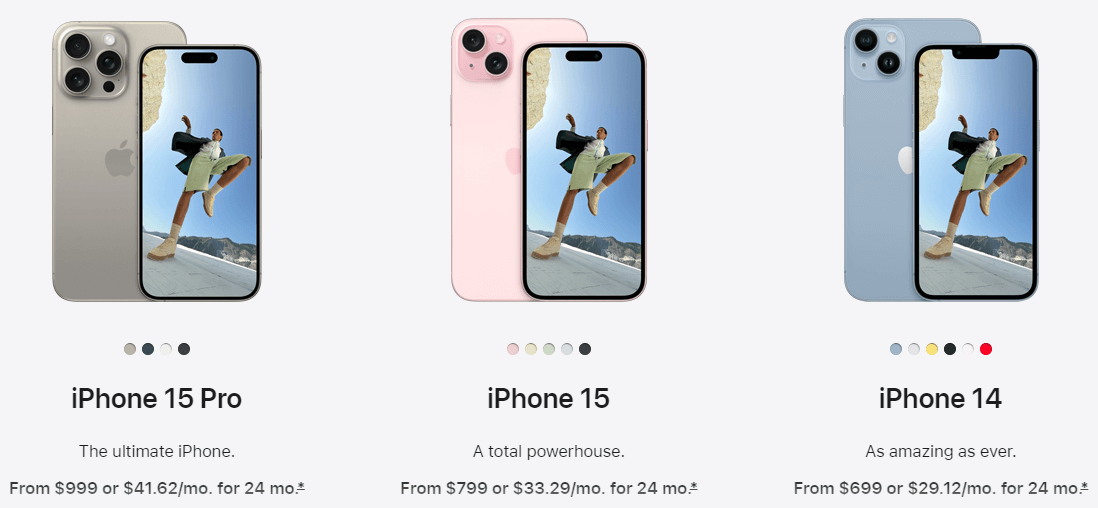
Provide the JavaScript code to run on the website to convert HTML to JSON. The output can be tested using the steps below:
Here is the sample JavaScript code, written by ChatGPT to extract the prices of iPhone:
// Find the product tile elements
const productTiles = document.querySelectorAll('.product-tile');

// Initialize an array to store the product data
const products = [];

// Iterate over each product tile
productTiles.forEach(tile => {
    // Extract product name
    const productName = tile.querySelector('.product-tile-headline').textContent.trim();

    // Extract product price
    const priceElement = tile.querySelector('.product-tile-price');
    const priceText = priceElement.textContent.trim().replace(/\s+/g, ' ');
    const priceRegex = /From\s*(\$\d+(\.\d+)?)(?:\s*or\s*)?(\$\d+(\.\d+)?)?/i;
    const match = priceText.match(priceRegex);

    let price;
    if (match) {
        const fromPrice = match[1];
        const monthlyPrice = match[3] ? match[3] : null;
        price = {
            from: fromPrice,
            monthly: monthlyPrice
        };
    } else {
        price = null;
    }

    // Add product data to the array
    products.push({
        name: productName,
        price: price
    });
});

// Display the results
console.log(JSON.stringify(products, null, 2));

// Return the results that will be included in the API
return products;
The JSON output is shown in the Console window:
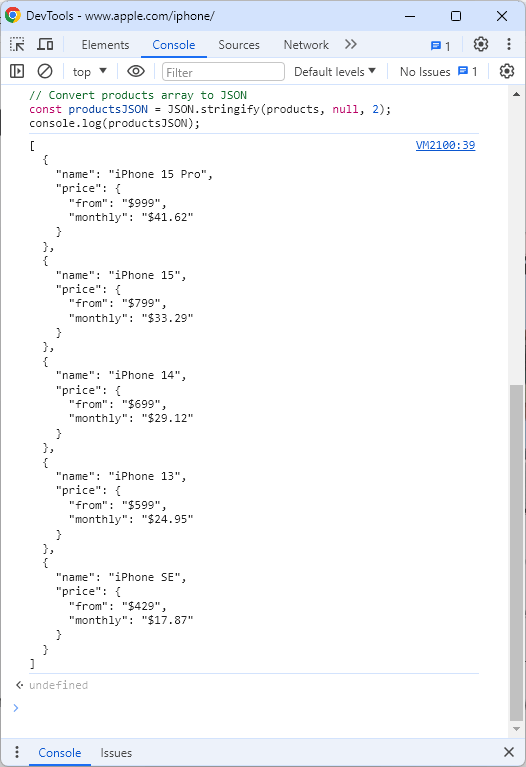
Add Screenshots automates the HTML to JSON conversion process by:
return productsJSON;Here's a sample request that will navigate to the https://www.apple.com/iphone/ website, execute the JavaScript code that has been base64 encoded, and then return JSON data as the response.
POST https://api.addscreenshots.com/screenshots/?apikey=YOUR_API_KEY

{
  "url": "https://www.apple.com/iphone/",
  "json": true,
  "data": {
    "script": "Y29uc3QgcHJvZHVjdFRpbGVzID0gZG9jdW1lbnQucXVlcnlTZWxlY3RvckFsbCgnLnByb2R1Y3QtdGlsZScpOwpjb25zdCBwcm9kdWN0cyA9IFtdOwoKcHJvZHVjdFRpbGVzLmZvckVhY2godGlsZSA9PiB7CiAgICBjb25zdCBwcm9kdWN0TmFtZSA9IHRpbGUucXVlcnlTZWxlY3RvcignLnByb2R1Y3QtdGlsZS1oZWFkbGluZScpLnRleHRDb250ZW50LnRyaW0oKTsKCiAgICBjb25zdCBwcmljZUVsZW1lbnQgPSB0aWxlLnF1ZXJ5U2VsZWN0b3IoJy5wcm9kdWN0LXRpbGUtcHJpY2UnKTsKICAgIGNvbnN0IHByaWNlVGV4dCA9IHByaWNlRWxlbWVudC50ZXh0Q29udGVudC50cmltKCkucmVwbGFjZSgvXHMrL2csICcgJyk7CiAgICBjb25zdCBwcmljZVJlZ2V4ID0gL0Zyb21ccyooXCRcZCsoXC5cZCspPykoPzpccypvclxzKik/KFwkXGQrKFwuXGQrKT8pPy9pOwogICAgY29uc3QgbWF0Y2ggPSBwcmljZVRleHQubWF0Y2gocHJpY2VSZWdleCk7CgogICAgbGV0IHByaWNlOwogICAgaWYgKG1hdGNoKSB7CiAgICAgICAgY29uc3QgZnJvbVByaWNlID0gbWF0Y2hbMV07CiAgICAgICAgY29uc3QgbW9udGhseVByaWNlID0gbWF0Y2hbM10gPyBtYXRjaFszXSA6IG51bGw7CiAgICAgICAgcHJpY2UgPSB7CiAgICAgICAgICAgIGZyb206IGZyb21QcmljZSwKICAgICAgICAgICAgbW9udGhseTogbW9udGhseVByaWNlCiAgICAgICAgfTsKICAgIH0gZWxzZSB7CiAgICAgICAgcHJpY2UgPSBudWxsOwogICAgfQoKICAgIC8vIEFkZCBwcm9kdWN0IGRhdGEgdG8gdGhlIGFycmF5CiAgICBwcm9kdWN0cy5wdXNoKHsKICAgICAgICBuYW1lOiBwcm9kdWN0TmFtZSwKICAgICAgICBwcmljZTogcHJpY2UKICAgIH0pOwp9KTsKCnJldHVybiBKU09OLnN0cmluZ2lmeShwcm9kdWN0cywgbnVsbCwgMik7"
  }
}
Your API key can be found on the API Keys page. Need an API Key? Sign up to get started.
For internal applications, replace YOUR_API_KEY with your own unique API Key.
For public facing websites or hotlinks, generate a signed URL.
The conversion response is shown below:
{
  "response": {
    "success": true,
    "processed": "2024-05-09T00:18:01.431Z",
    "data": [
      {
        "name": "iPhone 15 Pro",
        "price": {
          "from": "$999",
          "monthly": "$41.62"
        }
      },
      {
        "name": "iPhone 15",
        "price": {
          "from": "$799",
          "monthly": "$33.29"
        }
      },
      {
        "name": "iPhone 14",
        "price": {
          "from": "$699",
          "monthly": "$29.12"
        }
      },
      {
        "name": "iPhone 13",
        "price": {
          "from": "$599",
          "monthly": "$24.95"
        }
      },
      {
        "name": "iPhone SE",
        "price": {
          "from": "$429",
          "monthly": "$17.87"
        }
      }
    ]
  }
}
Use the interactive builder to generate the API payload, then scale the same workflow across your target pages.