Schedule Website Screenshots Hourly, Daily, or with Cron
Schedule website screenshots to run automatically every few minutes, hourly, daily, weekly, monthly, or on a custom cron expression. Each schedule combines the pages to capture, reusable browser settings, and a delivery destination so your visual records arrive without manual screenshots.
- Flexible cadence: Choose presets or build cron expressions for complex business hours.
- End-to-end orchestration: Pair schedules with storage templates, request templates, and visual diff reporting.
- Global reach: Capture from three regions and multiple device profiles without concurrency limits.
- Secure archiving: Store screenshots in S3, Azure, GCP, Cloudflare R2, FTP, webhooks, or email automatically.
Create your first schedule free See the three-step setup

Choose a destination, reuse the capture settings you need, and then decide when the job runs:
How to Schedule Screenshots
Access scheduling through the left side menu after logging into the Add Screenshots Portal.
Capture screenshots in just three simple steps:
- Storage Account Template - Define the destination for storing screenshots.
- Request Template - Customize how screenshots are captured (optional).
- Schedule - Set which websites to capture and the timing for captures.
Storage and request templates are reusable, allowing you to set up different schedules for various websites.
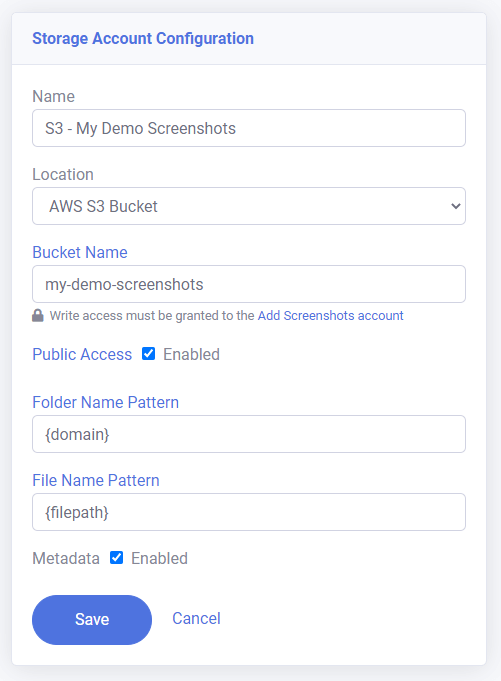
1. Storage Account Templates
Create reusable templates for where your screenshots are stored, including options such as:
Specify folder names and file names with configurable path patterns for organized storage.
Example storage account configuration:
2. Request Templates
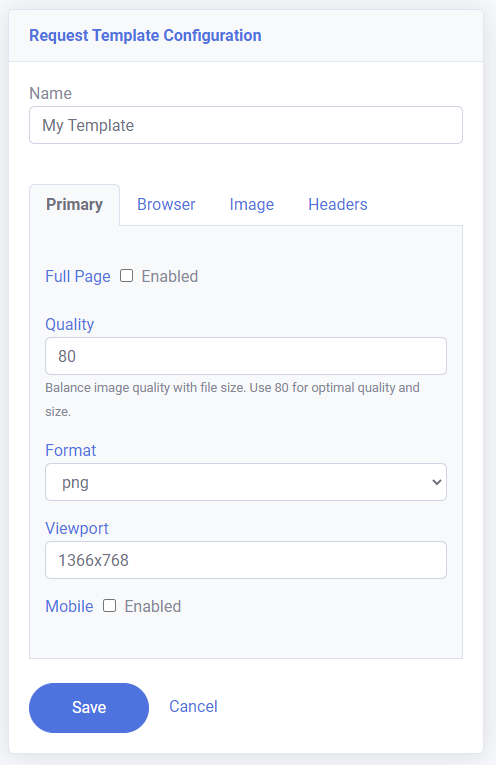
Create reusable request templates to define how screenshots are taken, including options like viewport size, image quality, file format, and more.
Example request template:
3. Schedules
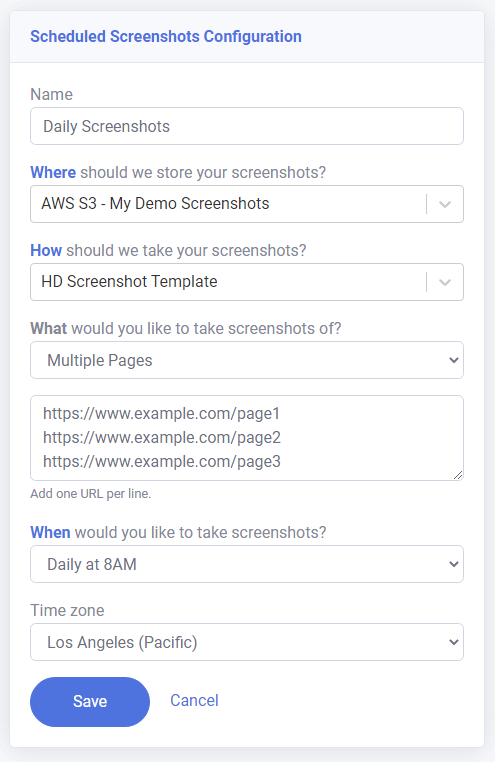
Set up one or multiple schedules based on your needs, specifying the websites to capture, the timing, and the capturing method.
Example of a multi-page screenshot configuration:
Creating Custom Schedules
Create custom schedules using a CRON expression, which is a time-based scheduling format.
Check the schedule time zone
Before activating a recurring capture, confirm the time zone shown for the schedule and review the next run time. This is especially important for reports tied to local business hours or daylight-saving changes. For evidence and compliance workflows, include the capture time and region in your folder or file name pattern.
CRON Expression Format
The CRON expression format is: {minute} {hour} {day of the month} {month} {day of the week}
Example: * * * * * (runs every minute)
Allowed values for each field:
| Field | Valid Values |
|---|---|
| Minute | 0-59 |
| Hour | 0-23 |
| Day of the month | 1-31 |
| Month | 1-12 |
| Day of the week | 0-6 (Sunday to Saturday) |
CRON Expression Examples
Use crontab.guru for an easy-to-use CRON scheduler expression editor.
| Expression | Description | Runs at |
|---|---|---|
| * * * * * | every minute | 09:00 09:01 ... 10:01 |
| */5 * * * * | every 5 minutes | 09:00 09:05 ... 10:05 |
| 0 * * * * | every hour (hourly) | 09:00 10:00 ... 11:00 |
| 0 */6 * * * | every 6 hours | 06:00 12:00 ... 18:00 |
| 0 8-18 * * * | every hour between 8-18 | 08:00 09:00 ... 18:00 |
| 0 0 * * * | every day (daily) | Feb 1 00:00 ... Feb 2 00:00 |
| 0 10 * * * | every day at 10:00 | Feb 1 10:00 ... Feb 2 10:00 |
| 0 * * * 1-5 | every hour on workdays | Feb 7 (FRI) 23:00 ... Feb 10 (MON) 00:00 |
| 0 0 * * 0 | every Sun (weekly) | Feb 9 (SUN) 00:00 ... Feb 16 (SUN) 00:00 |
| 0 9 * * 1 | every Mon at 09:00 | Feb 3 (MON) 09:00 ... Feb 10 (MON) 09:00 |
| 0 0 1 * * | every 1st of the month (monthly) | Feb 1 00:00 ... Mar 1 00:00 |
| 0 * * * 0 | every hour on Sun | Feb 9 (SUN) 23:00 ... Feb 16 (SUN) 00:00 |
| 0 0 1-7 * 0 | every first Sun of the month at 00:00 | Feb 2 (SUN) 00:00 Apr 1 (SUN) 00:00 |
| 5 23 * * * | daily at 23:05 (11:05 pm) | Feb 2 23:05 ... Feb 3 23:05 |
| 45 23 * * 6 | every Sat at 23:45 (11:45 pm) | Oct 24 23:45 ... Oct 21 23:45 |
| 0 9 * * 1 | every Mon at 09:00 | Oct 19 09:00 ... Oct 26 09:00 |
What can scheduled website screenshots automate?
- Competitor monitoring: Build a consistent visual history of pricing, promotions, landing pages, and product launches.
- Compliance records: Preserve dated evidence of disclosures, consent banners, policies, and regulated marketing content.
- Visual QA: Capture important pages after releases and compare them with earlier renders to spot unexpected layout changes.
- Client and internal reports: Deliver recurring screenshots to cloud storage, email, or a webhook for downstream reporting.
Schedule, capture, and deliver in one workflow
A schedule controls when the job runs. The linked request template controls how the browser captures each page, including viewport, full-page mode, waits, image format, and browser actions. The storage template then controls where every result is delivered.
For a visual history rather than a simple archive, connect the schedule to before, after, and diff screenshots. For large URL sets, use bulk website screenshots with a sitemap or list.
Want help configuring always-on monitoring? Review plans or create an API key to start scheduling captures in minutes.